

Restoration of the Isakça Mahmut Yazıcı Mosque in Romania (2021–2022)
Restoration of the Mahmud Yazıcı Mosque in Isaccea, Romania (2021–2022)
1. History and Location
The Mahmud Yazıcı Mosque in Isaccea is a historical mosque located in the town of Isaccea in the Tulcea region of Romania.
It was built in this settlement on the banks of the Danube, where Turks lived in large numbers during the Ottoman period.
While the exact construction date of the historical structure is uncertain, Turkish sources suggest it was built around 1771, while Romanian sources indicate it was restored around 1860.
This suggests the structure has existed since the 18th century, but there may be disagreements among different sources regarding the original date.
General Description and History of the Structure
In research conducted by Ekrem Hakkı Ayverdi, based on documents in the archives of the General Directorate of Foundations and the General Directorate of Land Registry and Cadastre, it is learned that 291 structures were built in Romania during the period of Turkish rule. The Mahmud Yazıcı Mosque is among them.
The only mosque still standing in Ishakça, the Mahmud Yazıcı Mosque, has an inscription measuring 44 x 90 cm, written in the Thuluth script, consisting of ten couplets, above its entrance gate. The inscription does not provide any information about the identity of Mahmud Yazıcı, who is listed as the builder.
Our oldest source regarding the Mahmud Yazıcı Mosque is an engraving showing Ishakça in Hector de Bearn’s work “Quelques Souvenirs d’une Campagne en Turquie,” published in 1839. The inscription on the structure, which stands today, corresponds to the year 1280 Hijri, corresponding to 1863-1864 AD. It is known that during the Ceaușescu era, despite being a registered historical site, the building faced the threat of collapse. It was saved through the efforts of the Mufti’s office and the Turkish Embassy, but the tombstones in the courtyard were lost, and the old cemetery and fountain were destroyed during road construction.
The hypothesis put forward by C. Bracacescu and M. Maxim, that the new mosque was built or rebuilt as a result of the destruction of the fortress and mosque by Russian soldiers in 1771, and that its new patron was Mahmud Yazıcı, can be accepted as a reconstruction based on the absence of any information about repairs in the inscription.
In Ekrem Hakkı Ayverdi’s book published in 1981, the Mahmud Yazıcı Mosque is described in detail, with plans, photographs, and surveys of the ceiling and central medallion.
In his work on Ottoman architecture in Romania, Turgay Yazar states that, according to the inscription, the patron of the building was Mahmud Yazıcı. Based on Ekrem Hakkı Ayverdi’s reference, he points out that the door to the south of the minaret was opened before 1977. Based on visual documents obtained from the local people in the 1980s, he determined that the upper part of the last prayer area was renovated and its walls plastered.
In Filiz Halil’s memoir, published in 2004, information about the mosque’s inscription and architecture is provided. She mentions the mosque’s solidity and the quality of the materials used in its repair in 1995, commissioned by an Arab Muslim and designed by architect Tudor Vuocila.
Besides our written sources, Memnune Ömer, the granddaughter of the imam born in 1865 who came to Shumen at the age of 20 and later served as imam at the Mahmud Yazıcı Mosque in İsakça until his death in 1956, has lived in İsakça for 74 years and provides the following information about the mosque: She notes that the mosque always had a prayer hall and recalls the cemetery and the turbaned tombstone in the mosque’s courtyard, which no longer exist. She states that the mosque regained its function in 1989, that an imam returned, and that it remained closed during the regime’s rule. In 1994, when the wooden columns of the northern entrance were removed, one was kept, preserving one of the original columns and providing us with important data. It was learned verbally from both religious officials and Nazif Ömer, the head of the İsakça Turkish Community, that an Iraqi businessman provided assistance to the mosque in 1994, and that the plaster and minaret were reinforced during the restoration, and the ground was strengthened in 2010.
During the repairs in 1995, the interior and exterior plaster of the mosque was removed, replastered, and repainted. All wooden parts except the ceiling – the pulpit, minbar, columns, windows, etc. – were repainted. In 2010, through the Romanian Ministry of Culture, the mosque’s ground was reinforced with mortar (cement) by drilling two rows of holes, half a meter apart, one row 3 meters deep and the other 1.5 meters deep, using a special tool.
2. Architectural Features
The mosque was constructed using stone, brick, and wood.
At the entrance there is a prayer hall (a section open to the courtyard) and a portico with wooden columns in front of it.
The minaret is approximately 25 m high and has a body made of stone/brick.
Interior:
There is a single main prayer hall.
There are galleries separated by columns on the sides and at the entrance, providing both structural and functional order.
On the mihrab side, there is a stone slab bearing an Arabic inscription.
Architecturally, the structure represents a simple but functional typology with Mediterranean/Ottoman influences; wide eaves, arched openings, and wooden elements stand out.
3. Restoration History
The structure has undergone multiple repair/restoration processes throughout its history:
1860s
The restoration named after Mahmut Efendi was carried out at this time.
and 20th centuries
A major maintenance/repair was carried out in 1886,
Interventions such as plastering the minaret and interior painting were carried out in 1916.
20th century – TIKA Restoration Process
Since 2021, a comprehensive restoration work has been carried out by TIKA (Turkish Cooperation and Coordination Agency).
These works were carried out to stabilize the structure, which was on the verge of collapse, and to preserve its original texture.
The inscription restoration was carried out by expert academic teams from Istanbul.
Decorative elements such as calligraphic panels were also renewed, taking into account their original aesthetics.
This restoration, carried out after more than a decade of local effort and permitting processes, is important in terms of the preservation of Ottoman-era artifacts in Romania.
4. Restoration Techniques
The technical approach of the restoration generally included the following elements:
1) Structural Strengthening
The load-bearing properties of the stone foundation walls and the minaret were examined in detail and strengthened with appropriate hydraulic-based binders and brick load-bearing elements.
Cracks and fractures were strengthened with appropriate material injection.
2) Preservation of Original Architectural Details
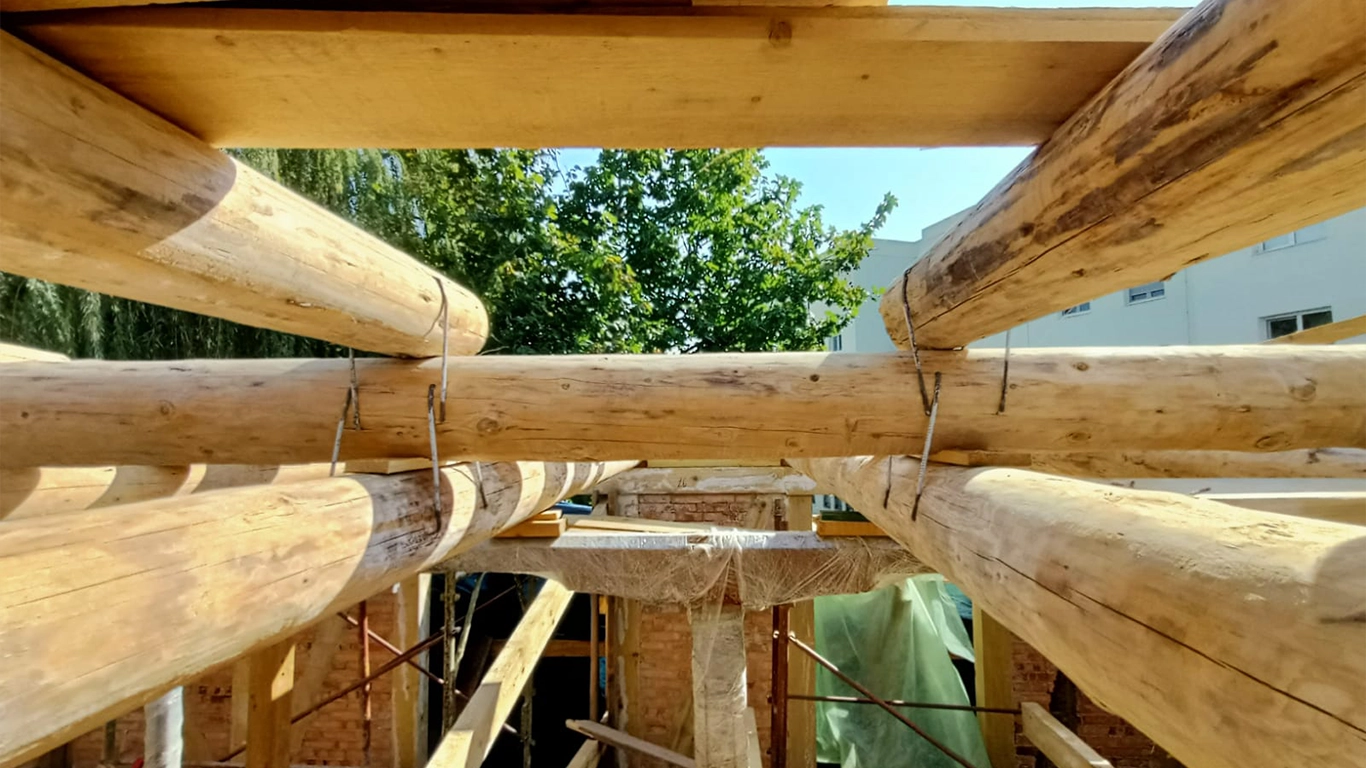
Wooden elements (porch columns, roof eaves, floor and ceiling coverings, roof, decaying wooden frames in the walls) were repaired and strengthened with materials appropriate to their original forms.
The original stone and brickwork has been preserved, and where necessary, new materials have been used to replace them without compromising the historical integrity of the structure.
3) Surface Cleaning and Restoration
Accumulated dirt, biological deposits, and old paint layers on wooden surfaces have been cleaned using non-destructive techniques.
Meticulous cleaning and calligraphy restoration have been carried out on inscriptions and decorations by a team of experts.
4) Contemporary Conservation Approach
According to modern restoration principles, fidelity to the original architectural texture and the preservation of the historical identity of the building are prioritized.
Restoration has been carried out without unnecessary modern additions or de-historicization.
These techniques are applied in accordance with international conservation principles for Ottoman-era stone/wooden structures.
5) Why is Restoring the Structure Important?
The İsakça Mosque is a significant cultural and architectural heritage site, being one of the few Ottoman-era mosques with minarets in Romania.
TİKA’s restoration work is part of this shared historical and cultural heritage preservation goal.
KiTABE
Mahmut Yazıcıyı Mudam
Ettikçe Hayra İtmam
Ecru Sevabı İltizam
Allah Muvaffak Eylesin.
Edup İşakça da Bina
Bu Camii Aldı Dua
Cümle Ahaliyi Kaza
Mesrur Oldular Bütün.
Alemin Böyle Bir Eser
Namın Anın İbka Eder
Bu Hikmetin Nevi Beşer.
Şükr u Sipas Eylesin.
Sarf Eyledikçe Himmetin
Hayrata Vakt-i Kudretin
Hak Itibar Ve Servetin
Mezdad Eyler Günbegün.
Tahsin Eyler Raşid Dahi
Tarihin İnşaat Eyledi
Yaptı Bu Ala Camii
Mahmut YAZICI Hayru İçin.
H.1280