

Restoration of Sultan Murat (Bazaar) Mosque in Pristina, Kosovo (2022)
Restoration of Sultan Murat (Bazaar) Mosque in Pristina, Kosovo (2022)
1. History and Background
The Sultan Murat Mosque is one of the oldest mosques in Pristina and an important legacy from the Ottoman period.
It was built in 1389 by Sultan Bayezid I in memory of the martyrdom of Murad I in the First Battle of Kosovo in 1389. Its construction most likely continued later, during the reign of Murad II, and was completed during the time of Mehmed I (the Conqueror).
In the early period after the Ottoman conquest of Kosovo, Ottoman architectural works emphasizing the artistic understanding of the time were built. Among these, mosques were the most numerous type of structure.
In modern urban environments, mosques provide an attractive harmony with their strong architectural styles, forming a beautiful unity with other objects and monuments.
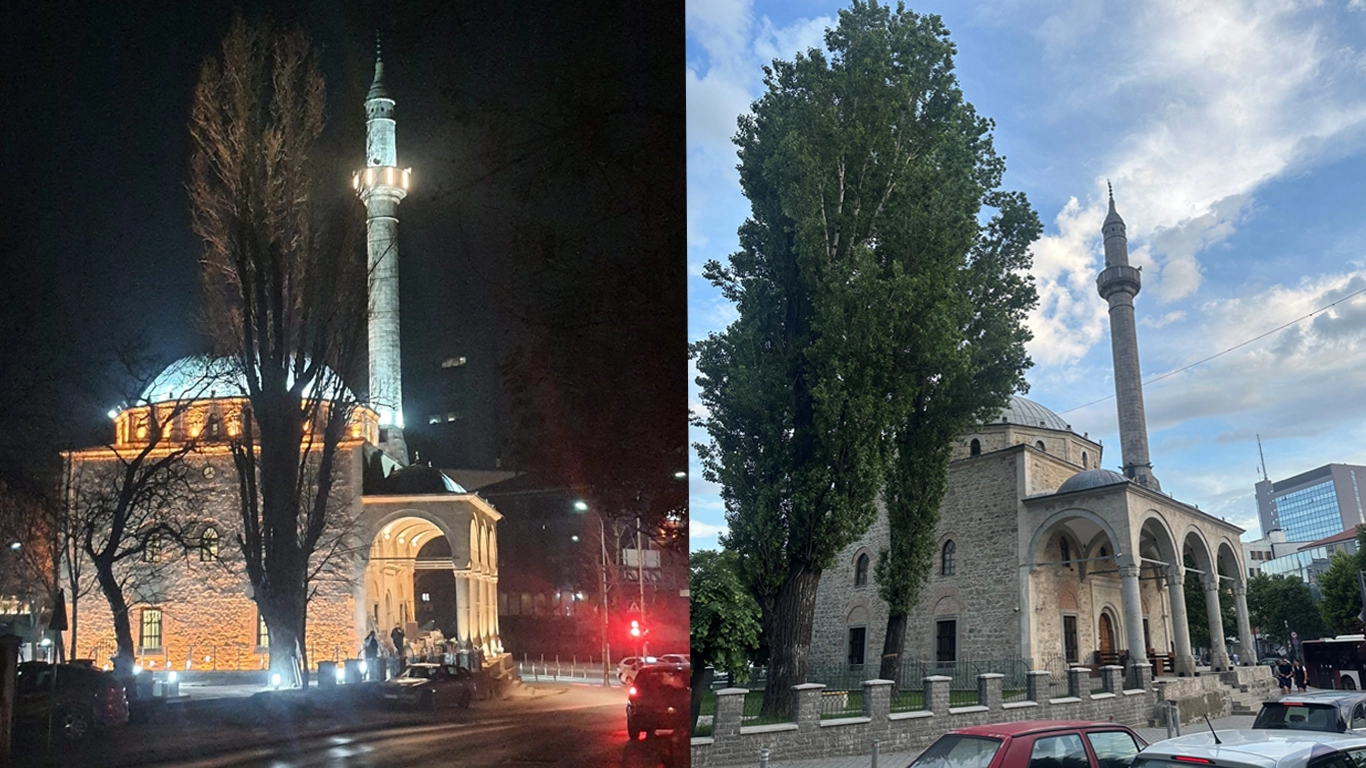
Today, the Sultan Murat Mosque is located in the very center of Pristina, opposite the Assembly of the Republic of Kosovo and the Museum of Kosovo. The Ibrahim Lutfiu Mosque is located between Agim Ramadi and Zejnel Salihu streets. During a restoration project that began between 2010 and 2012 and was left incomplete, the mosque was closed for worship. After the walls of its four-cornered courtyard were removed during the 2010-2012 restoration, it was surrounded by metal plates to define its boundaries. When it was open, this mosque, which served as a marketplace, hosted five daily prayers. Including the last prayer area, the mosque had a capacity of 300 worshippers. The mosque was not damaged during the 1999 Kosovo War.
The Sultan Murat Mosque (Little Fatih Mosque) in Pristina is one of the oldest examples of Ottoman architecture not only in Kosovo but in all of Europe. The construction of the first mosques in Kosovo was done in honor of conquests. The foundation of the Bazaar Mosque was laid by Bayezid I in 792/1389, its construction continued during the reign of Sultan Murad II, and its final construction was completed by Sultan Mehmed the Conqueror.
The people of Pristina also call this mosque Camii Sagir, Muradiye, Çarşı, and Taş Camii. In Ottoman sources, it is also referred to as Küçük Fatih Camii (Little Fatih Mosque). Over the years, it has undergone some changes and has not been able to fully preserve its original appearance. It is said that the mihrab and minbar were the least altered parts during these repairs and changes.
Other Names:
Çarşı Camii / Bazaar Mosque (Old Bazaar Mosque)
Taş Camii / Stone Mosque (due to the stone structure of its minaret)
Sultan Murat Camii (Mosque commemorating Sultan Murad)
Historical Significance
It is one of the first examples of Ottoman mosques in the Balkans.
It is located in the city center of Pristina, at the entrance to the old bazaar area.
It is considered one of the early symbols of Ottoman cultural identity in the city.
2. Architectural Features
Architectural Style
It bears the characteristics of early Ottoman architecture; it is built with simple and solid stone masonry.
The main hall of the mosque, built of stone, features a dome and a traditional minaret.
The structure dominates its location and has a volume that is harmonious with the surrounding settlement.
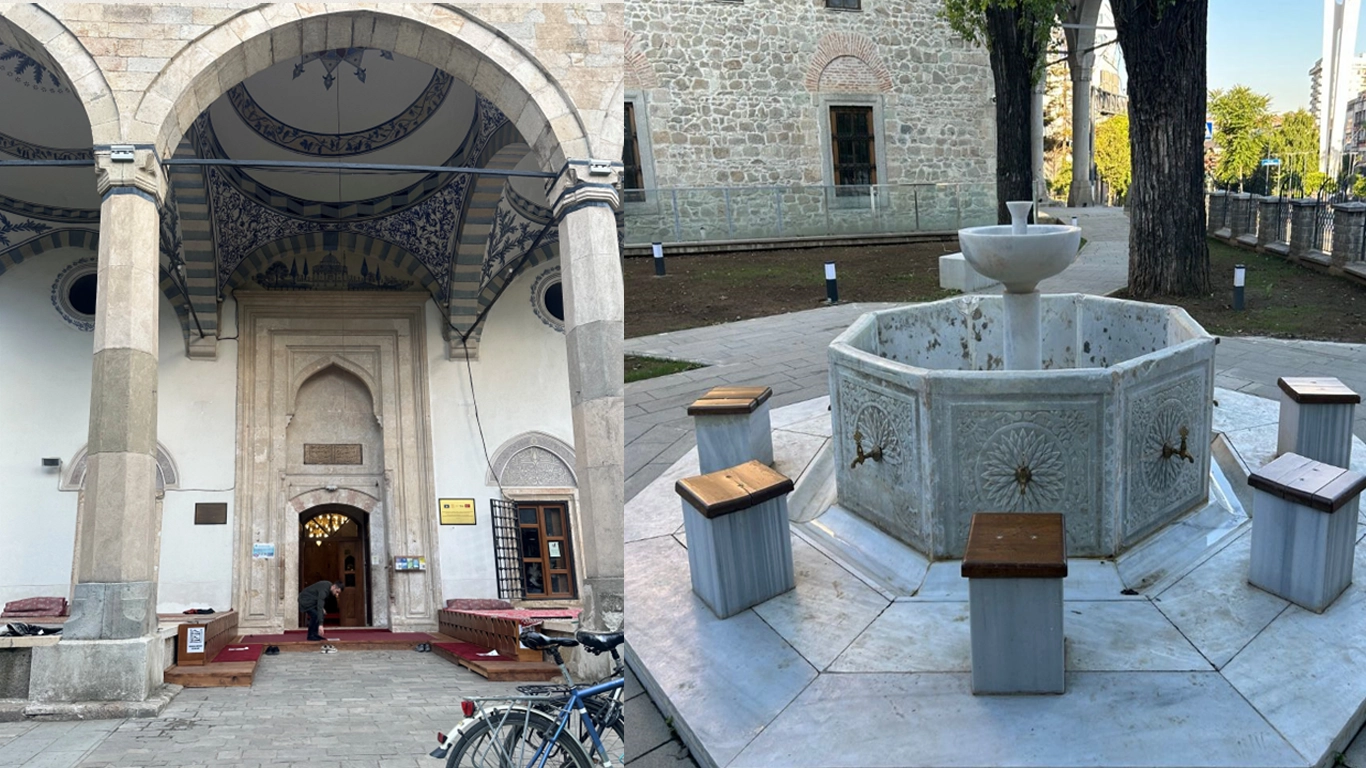
The mosque building is constructed on square stone foundations with walls made of roughly hewn stone and Khorasan mortar. Old photographs show that the exterior was plastered with a yellowish plaster; however, as part of a restoration project, the plaster has been removed, revealing the stone wall structure.
The fact that the mosque exhibits characteristics of architectural works built during the reign of Mehmed the Conqueror suggests that it was completed by him. Furthermore, the fact that it shares many similarities with the nearby Fatih Mosque, also from the Mehmed era, strengthens this claim.
Structural Elements
Main Space: Single-domed structure.
Minaret: The stone-built minaret is one of the characteristic elements of the building (hence it is known as the “Stone Mosque”).
Plan: A simple and functional place of worship, adhering to the typical Ottoman mosque plan.
Inscription and Document: Unfortunately, the original endowment inscription of the mosque has not survived to the present day.
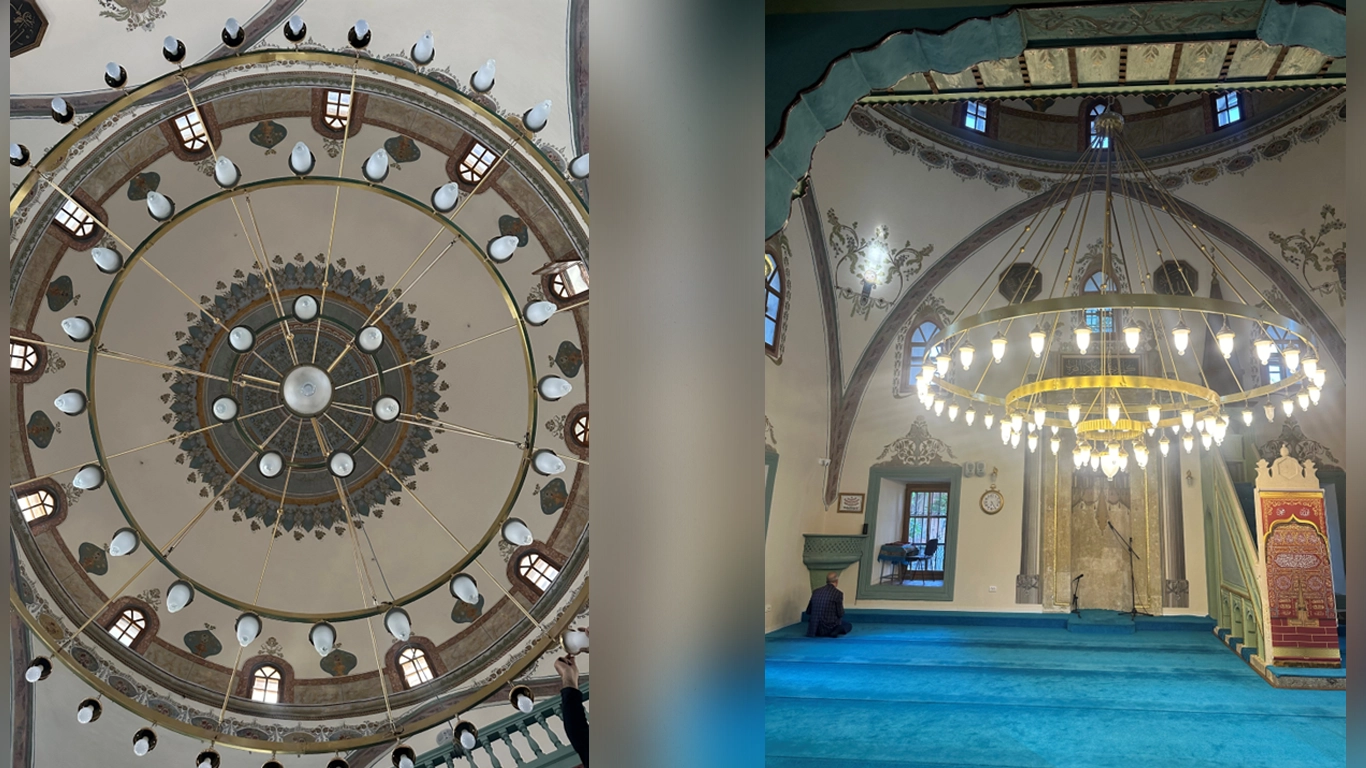
The mosque measures 10.30 x 10.45 meters internally. It is covered with a single brick dome. The stone body walls are approximately 130 cm thick. The transition elements to the dome are pendentives. All windows are designed to widen inwards to allow more light to enter. In addition, there are two elephant’s eye windows near the dome drum on the northeast and southwest facades of the mosque. Pendentives are used as transition elements to the lead-clad dome. The drum is dodecagonal. Each corner is decorated with reliefs.
3. Restoration & Repair Interventions
Historical Preservation Status
The mosque is one of the important cultural heritage sites under the protection of the Kosovo state.
In the 1990s, it was declared a “cultural monument of exceptional importance” by Serbia.
Restoration Works
In 2018, a protocol was signed between the Kosovo Municipality and the Turkish Cooperation and Coordination Agency (TİKA) of Turkey regarding the restoration works for the Sultan Murat (Çarşı) Mosque. This protocol was implemented jointly with the Kosovo Ministry of Culture and the Islamic Union of Kosovo.
The aim was to strengthen the structure, restore it while preserving its original architectural features, and pass on the historical fabric to future generations.
Intervention Challenges
Past restoration attempts have been hampered by financial and administrative reasons. Projects initiated in the 2010s, in particular, could not be completed as planned, which negatively impacted the structure.
Conservation Approach
The following aspects are prioritized in restoration projects:
Preservation of original stone material
Structural strengthening
Respect for the historical fabric
Aesthetic and functional improvement
Balancing tourism and religious functions
These approaches have been implemented through projects aimed at being carried out in accordance with international heritage conservation standards.
4. Importance and Current Status
Cultural and Historical Value
It is the oldest mosque in Pristina dating back to the Ottoman period and is one of the examples of early Ottoman architecture in the Balkans.
It plays an important role in shaping the city’s identity.
Restoration work has been ongoing for a long time and was completed as of 2023.
Restoration Techniques Applied in Sultan Murat Mosque
1. Restoration Approach and Theoretical Framework
The restoration interventions applied to the structure are primarily based on the following principles:
Venice Charter (1964)
Nara Authenticity Certificate (1994)
Principle of minimum intervention
Reversibility
Material and technical compatibility
In this context, the restoration of the Sultan Murat Mosque was approached with a focus on preservation and conservation, avoiding reconstruction.
2. Documentation and Analytical Studies
2.1 Survey Studies
Recording the current state of the structure using laser scanning, manual measurement, and photographic documentation methods.
The stone wall masonry, joint structure, minaret body, and dome transition elements have been documented in detail.
2.2 Material Analyses
In stone samples:
Petrographic analysis
Salinity tests
In mortars:
Determination of binder-aggregate ratio
Lime-based mortar analysis
Aim: To produce a repair mortar closest to the original material
Stone Structure Restoration Techniques
3.1 Stone Consolidation
Techniques used:
Microinjection (lime-based injection mortar)
For stones with weathered surfaces:
Cement-based materials were specifically avoided because:
Salt efflorescence
Hardness difference
Creates stone loss in the long term
3.2 Joint Repairs (Repointing)
Damaged cement joints were mechanically cleaned.
In their place:
Mortar containing hydraulic lime (NHL) + natural aggregate was applied.
The joint profile was rearranged to match the original joint depth and form.
This method provides breathability in Ottoman stone mosques. It is a fundamental principle in this regard.
3.3 Stone Restoration (Plastic Repair)
For missing or severely damaged stones:
Restoration according to the principle of anastylosis
New stone additions:
Geologically similar to the same quarry
Distinguishable from the historical surface, but without compromising visual integrity
4. Dome and Supporting System Interventions
4.1 Static Strengthening
Cracks in the dome drum:
Lime injection
4.2 Dome Cladding
Waterproofing:
Traditional lead cladding system preserved
Hand-forged lead sheets used in missing areas
5. Minaret Restoration
5.1 Structural Interventions
In the minaret body:
Joint renewal for vertical cracks
Stone consoles under the balcony:
Mechanical cleaning
5.2 Surface Cleaning
Low-pressure water
Mechanical (manual) cleaning
Chemical cleaning was very limited and applied after testing areas.
6. Interior Conservation
6.1 Plaster and Surfaces
Late cement-based plasters removed
Replaced with:
Traditional lime-based plaster
Layer analysis conducted, original paint traces documented
6.2 Wooden Elements
In the Gallery
Anoxic disinfection
Protective application with natural resins
No varnish or synthetic coating used
The restoration of the Sultan Murat Mosque is a significant example of:
Conservation-oriented restoration
Scientific conservation methods
Application in accordance with international conservation principles
for Ottoman stone mosques in the Balkans.
Institutional Framework of the Restoration Project
In 2018, a restoration protocol was signed between TIKA (Turkish Cooperation and Coordination Agency), the Ministry of Culture, Youth and Sports of Kosovo, the Kosovo Institute for the Protection of Monuments, and the Islamic Union of Kosovo. These institutions jointly carried out the project.
The project is based on compliance with local conservation authorities, adherence to international conservation principles, and the scientific conservation of cultural heritage.
Restoration Implementation Objectives and Approach
The general objectives and areas of approach are as follows:
1) Preservation of the Stone Structure
Since the main structure of the building is entirely made of stone, the main focus of the restoration is to stabilize the stone masses and control stone deformations.
Cracks, surface deterioration, and material separation that have occurred over time, especially in the minaret and walls, have been addressed.
2) Restoration of Historical Architectural Identity
In Ottoman-era structures such as the Bazaar Mosque, preserving the original architectural character is the main principle of restoration.
The aim is to preserve the original form of the structure, especially the window design, dome transition elements, and minaret silhouette, in accordance with its historical character.
3) Surveying and Documentation
At the beginning of the project, surveying (measurement and drawing studies) and detailed documentation of the existing situation formed the basis of the restoration plan.