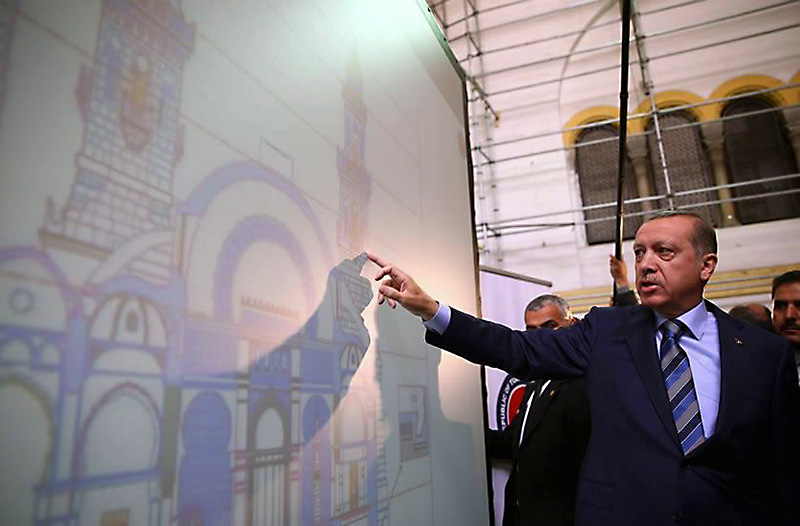


Restoration of Keçiova Mosque, Algeria (2014-2018)
1. Historical Background and General Description
Origins and the Ottoman Period
The Ketchaoua Mosque is located in the historic Casbah district of Algiers, the capital of Algeria, and is one of the most significant surviving monuments from the Ottoman period. An engraving published in Civitates Orbis Terrarum by Braun and Hogenberg in 1575—most likely drawn by Antonio Salamanca around 1541—clearly depicts a domed mosque with a cylindrical minaret featuring a single balcony, built in the first half of the 16th century within the courtyard of an Ottoman palace. This palace was situated at the site of today’s mosque, then identified as Piazza del Re (Government Square), and surrounded by examples of Ottoman-era civil architecture and historic residences.
This structure, considered the earliest Ottoman building in the city, has been claimed to be the mosque commissioned by Barbaros Hayreddin Pasha in 926 AH / 1520 AD, of which only the inscription has survived to the present day. In one of two known 16th-century engravings, the mosque appears without a minaret; in the other, it is depicted with a cylindrical, single-balcony minaret and a single-domed cylindrical or polygonal mass. This form is consistently shown in engravings from the 17th and 18th centuries as well.
At present, two marble plaques—one in Arabic and the other in French—located at the three-bay last congregation portico at the southern entrance of the mosque, state that the building was constructed in 1021 AH / 1612–13 AD as Sebil’ul-Hayrat for followers of the Hanafi school of Islam.
A marble inscription written in Arabic, currently preserved in the Algiers Museum of Antiquities, records that the mosque was rebuilt and enlarged by Hasan Pasha, the Dey of Algiers, in 1209 AH / 1794–95 AD. The expanded form of the mosque commissioned by Hasan Pasha is clearly visible in several engravings from the first half of the 19th century.
Transformation During the French Period
Following the French occupation beginning in 1832, the mosque was forcibly confiscated and dismantled, then converted into the Catholic Saint Philippe Cathedral. During this transformation, large portions of the original structure were demolished, new church elements were added, and the mosque’s Islamic architectural character was significantly altered. The cathedral, redesigned as a model of the so-called Neo-Moorish Architecture, was reopened for worship in 1908.
Post-Independence Period
After Algeria gained independence in 1962, the building was returned to its original function as a mosque. The first Friday prayer after independence was held here, and the Ketchaoua Mosque became a powerful symbol of national independence.
Architectural Features
Style and Influences
Due to successive interventions over different historical periods, the architectural character of the Ketchaoua Mosque is multilayered:
Ottoman–Moorish Architecture: A synthesis of Ottoman architectural principles and North African Moorish ornamentation.
Byzantine Influences: Certain Byzantine traces are visible, particularly in the entrance and façade compositions.
Hybrid Architectural Identity: The conversion of the mosque into a church and later reconversion into a mosque resulted in a departure from a classical mosque layout, creating a unique synthesis of architectural motifs.
Key Architectural Elements
Entrance: A portico accessed by a staircase of 23 steps, supported by four black-veined marble columns.
Minarets: Two octagonal minarets dominate the main façade.
Interior: Galleries formed by white marble columns, striking Moorish-style plasterwork, and domed spaces.
Tomb: The interior contains the grave of a missionary named San Geronimo, a remnant of the French period.
Repair and Restoration History
Early Interventions
The mosque suffered damage during the 2003 earthquake and was temporarily closed.
2009 Restoration Works
Around 2008–2009, the Algerian Directorate of Cultural Heritage initiated restoration works on critical areas, including the minarets, the central dome of the façade, and interior staircases. These interventions were carried out as part of a broader Casbah Restoration Program.
2013 Agreement and the TİKA Project
In 2013, a bilateral cooperation protocol was signed between Turkey and Algeria for the restoration of historical monuments. Within this framework, the restoration of the Ketchaoua Mosque was officially approved.
Major Restoration (2014–2018)
Restoration works began in 2014 and lasted approximately three years.
The project was implemented by the Turkish Cooperation and Coordination Agency (TİKA), with architects, archaeologists, and engineers from both Algeria and Turkey working collaboratively.
Main Objectives and Interventions:
Removal of church elements from the French period (altar, bema, etc.)
Faithful restoration based on the original Ottoman architectural layout
Structural strengthening of the minarets, façades, and main dome
Renewal of original calligraphy, ornamentation, and marble works in the interior
Reorganization of flooring, construction of new staircases, and renewal of carpets and interior decoration
Reopening in 2018
Following the completion of restoration works, the mosque was officially reopened between 9–13 April 2018 and resumed worship with the Friday prayer.
This restoration holds great cultural significance, both because the mosque is a symbol of Algerian independence and because it is located within the UNESCO World Heritage Site of the Casbah of Algiers.
Significance of the Interventions and Conservation Philosophy
Protection of Cultural Heritage
The restoration was conducted not merely as the repair of a place of worship, but as a comprehensive effort to preserve historical identity and architectural heritage.
Architectural Authenticity
Ottoman-period architectural identity was taken as the primary reference, while French-period additions were distinguished and, where possible, removed.
Collaborative Approach
The project involved technical teams from both Algeria and Turkey, and was reportedly closely monitored by UNESCO experts.
Importance and Current Status
The Ketchaoua Mosque is one of Algeria’s most important cultural and historical symbols and is regarded as a rare and outstanding example of Ottoman architecture in North Africa.
Today, it is open both for worship and for visitors, and remains one of the most prominent landmarks of the Casbah.
Ketchaoua Mosque (Algiers) – Technical Restoration and Intervention Analysis
Pre-Restoration Condition Assessment
Structural Problems
Following the 2003 Boumerdès Earthquake:
Vertical cracks in the minarets
Tensile cracks at the dome drum
Shear cracks in load-bearing arches
Due to French-period interventions:
Disruption of the original load-transfer system
Structural instability caused by heavy church additions
Material Deterioration
Salt crystallization, particularly in lower wall sections
Moisture-related deterioration:
Plaster blistering
Stone surface disintegration
Marble columns:
Surface erosion
Mechanical wear and biological soiling
Historical Stratification Issue
The building embodies multiple historical phases:
Ottoman mosque
French cathedral
Reconverted mosque
This created a conservation dilemma between preserving the documentary value of French-period elements and restoring Ottoman authenticity.
2. Restoration Approach and Conservation Principles
The restoration process was carried out in accordance with international conservation standards:
Venice Charter (1964)
Nara Document on Authenticity (1994)
UNESCO Casbah Management Plan
Adopted Core Principles:
Minimum intervention
Reversibility
Documentation-based restoration
Restitution with reference to the Ottoman period
3. Structural (Static) Interventions
Minaret Strengthening
Internal Measures:
Stainless steel core rods
Injection grouts based on hydraulic lime
External Measures:
Renewal of stone joints using traditional lime mortar
Objectives:
Increasing seismic resistance
Minimizing visual impact
Domes and Arches
Crack injection at the dome drum
Concealed steel tension systems
Reinstallation of weakened stones in arches using original materials and techniques
4. Material and Surface Restoration
Stone and Marble Elements
Cleaning:
Low-pressure micro-abrasion
Non-chemical (non-ionic) methods
Consolidation:
Ethyl silicate-based stone consolidants
Completion:
Compatible yet distinguishable stone additions in line with restoration ethics
Plaster and Decorative Painting
Removal of cement-based plasters from the French period
Application of traditional lime, sand, and brick powder mixtures
Reproduction of geometric and vegetal decorations with reference to the Ottoman period
Controlled restitution rather than full reconstruction
Flooring and Drainage
Installation of sub-floor moisture barrier drainage channels
Use of natural stone flooring and carpet systems
Objective:
Prevention of capillary moisture rise
5. Documentation and Monitoring
Throughout the restoration process:
3D laser scanning
Photogrammetry
Material analysis reports
Post-restoration:
Recommendation of a periodic structural monitoring program
Before / After