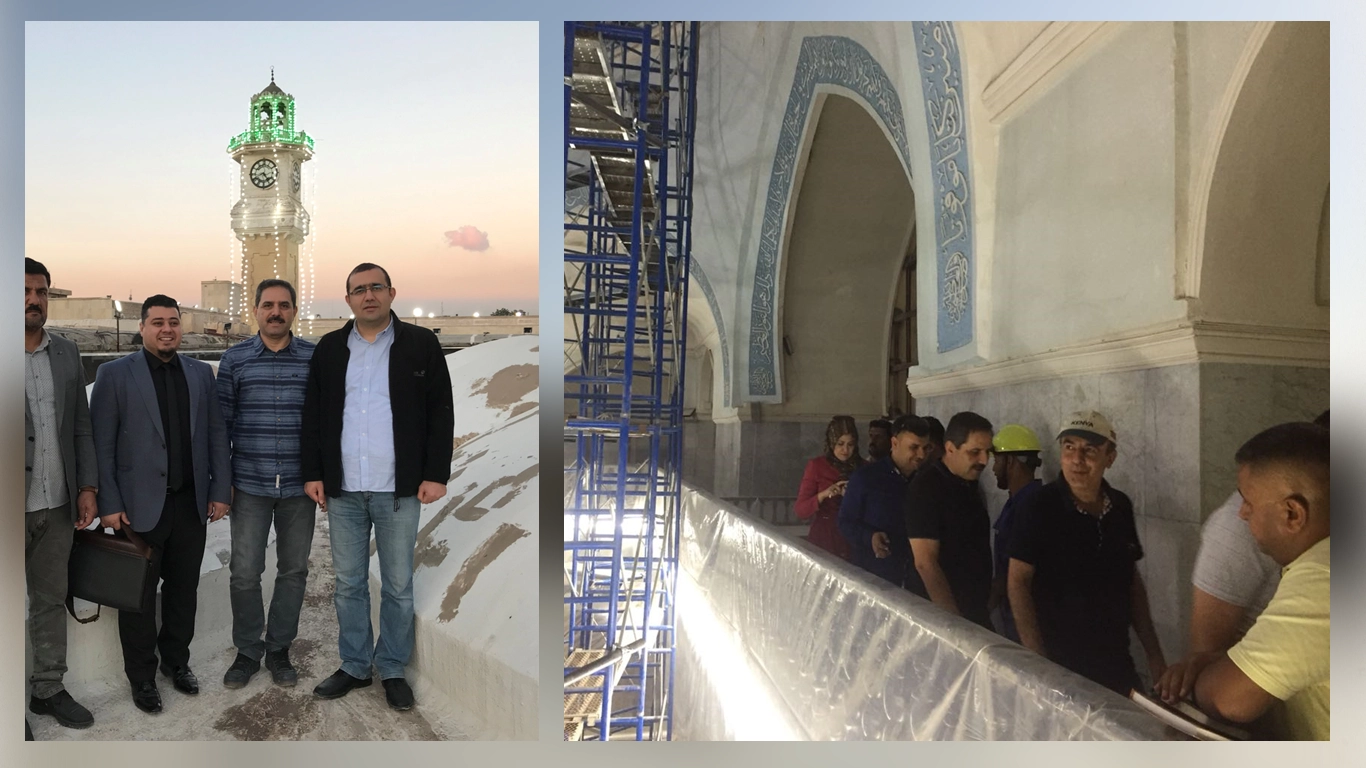


Restoration of the Abdulkadir Geylani Mosque and Tomb in Baghdad, Iraq (2018)
Restoration of the Abdulkadir Geylani Mosque and Tomb in Baghdad, Iraq (2018)
History and Location
Located in Baghdad, Iraq, on the east bank of the Tigris River, in the Rusafa district, within a large kulliya (Muslim worship and education complex).
This complex is named after Muhyi al-Din Abd al-Qadir al-Geylani (Abdulkadir Geylani), a Hanbali mufti, preacher, and great Sufi mystic. Geylani lived between 1077/1078 and 1166; as the founder of the Qadiriyya order, he is one of the most respected Sufi leaders in the Islamic world.
Historical Background
Who was Abdulkadir Geylani?
The building, originally constructed as a madrasa (religious school) in 540 (1145) by the Hanbali jurist Abu Said al-Mubarak ibn Ali al-Muharrami, was expanded and transformed into a tekke (Sufi lodge) by his student, Abdul Qadir Gilani.
Abdul Qadir Gilani, believed to have been born in the Gilan (Jîlân) region of Iran, received his education and grew up in Baghdad.
He is the founder of the Qadiriyya order, which had a great influence on Sufi thought; he is known for blending the Hanbali school of law with Sufism.
He died in Baghdad in 1166 and was buried there, within a complex built around a mausoleum (tomb).
Historical Development of the Mausoleum and Complex
Although the first mausoleum structure was built shortly after Gilani’s death, the existing complex was largely expanded in 1534 by the Ottoman Sultan Suleiman the Magnificent, commissioned to the architect Sinan. During this period, units such as a mosque, madrasa (educational institution), and imaret (soup kitchen) were added around the mausoleum, an arrangement typical of traditional Ottoman kulliyes (complexes).
The kulliye was repaired and strengthened many times during the Ottoman period. Damaged during the Persian invasion, it was largely renovated by Sultan Murad IV in 1048 (1638). Repairs were also carried out by Silahtar Hüseyin Pasha in 1085 (1674), Sultan Ahmed II in 1123 (1708), Sultan Abdülaziz in 1281 (1865), Sultan Abdülhamid in 1318 (1903), and between 1970-1976 and 1982-1984 by the Iraqi Ministry of Endowments and its trustees.
The tomb of Sheikh Abdurrahman has inscriptions dated 941 and 1123 AH on its wall, 1049 AH on its western portico, and 1318 AH on the main gate and courtyard walls.
Architectural Features
The complex, situated within a large courtyard surrounded by high walls, has an irregular plan. It consists of a tomb, mosque, madrasa, tekke cells, a summer mosque, and an imaret (soup kitchen). The tomb-mosque complex is in the center, while the other structures are located around the courtyard. A large garden and cemetery are located to the south of the complex.
The complex is a structure built in the classical Ottoman architectural tradition, incorporating functions of worship, education, and social welfare.
Mosque and Tomb Structure
Mosque: Located in the center of the complex; the mosque is directly connected to the tomb.
Tomb: Contains the grave of Abdulkadir Geylani; It is surrounded by a central domed structure, and the interior is generally enriched with marble, inscriptions, and dome ornamentation.
Architectural Style: It bears a classical influence characteristic of the Ottoman period but is blended with the local Baghdad building culture.
Courtyard and other units: Elements of the complex such as the madrasa and imaret are located around the mosque and mausoleum; the courtyard spaces regulate the flow of worship and visits.
Restoration and Intervention History
Ottoman Period Maintenance
The complex was preserved by the Ottoman administration through reconstruction and strengthening works in different periods (after 1534, Murad IV 1638, Ahmed III 1708, Abdulaziz 1865, Abdulhamid II 1903).
19th Century and Modern Restorations
It was restored between 1970–76 and 1982–84 during the time of the Iraqi Ministry of Endowments.
In 2007, the mausoleum and mosque were targeted by a bomb attack; serious damage occurred to the outer walls, dome, and minarets.
2010s – 2020s Restoration Works
A comprehensive restoration and revitalization project of the complex has been carried out since 2017 in cooperation with the Turkish Cooperation and Coordination Agency (TİKA) and relevant Iraqi institutions.
Within this scope, the dome, minbar, mihrab, chandeliers, carpets, and doors were rearranged, and the decorative paintings were renewed in accordance with Ottoman-era motifs.
Cultural and Religious Significance
The mausoleum of Abdulkadir Geylani is a symbolic pilgrimage site for both Sufi disciples and the Islamic world; his spiritual teachings spread across wide geographical areas through the Qadiriyya order.
The complex is an important part of Baghdad’s historical and cultural fabric, serving both as a place of worship and an example of classical Islamic complexes with educational and social functions.
Sources indicate that millions of people participate in worship, iftar (breaking the fast), and devotional activities here during Ramadan.